

Hydrokin
Hydrokinetic turbines (axial, H-Darrieus, Savonius and radial rotor): rotor design by BEMT or DMST, annual energy, STEP geometry, domain and mesh for Fluent Meshing, Fluent journal, GCI validation and report.
Version 1 · updated on Oct 23, 2026
Overview
Hydrokin designs hydrokinetic turbines — which extract energy from the current of rivers, channels and tides without a dam — and prepares the CFD simulation of the rotor.
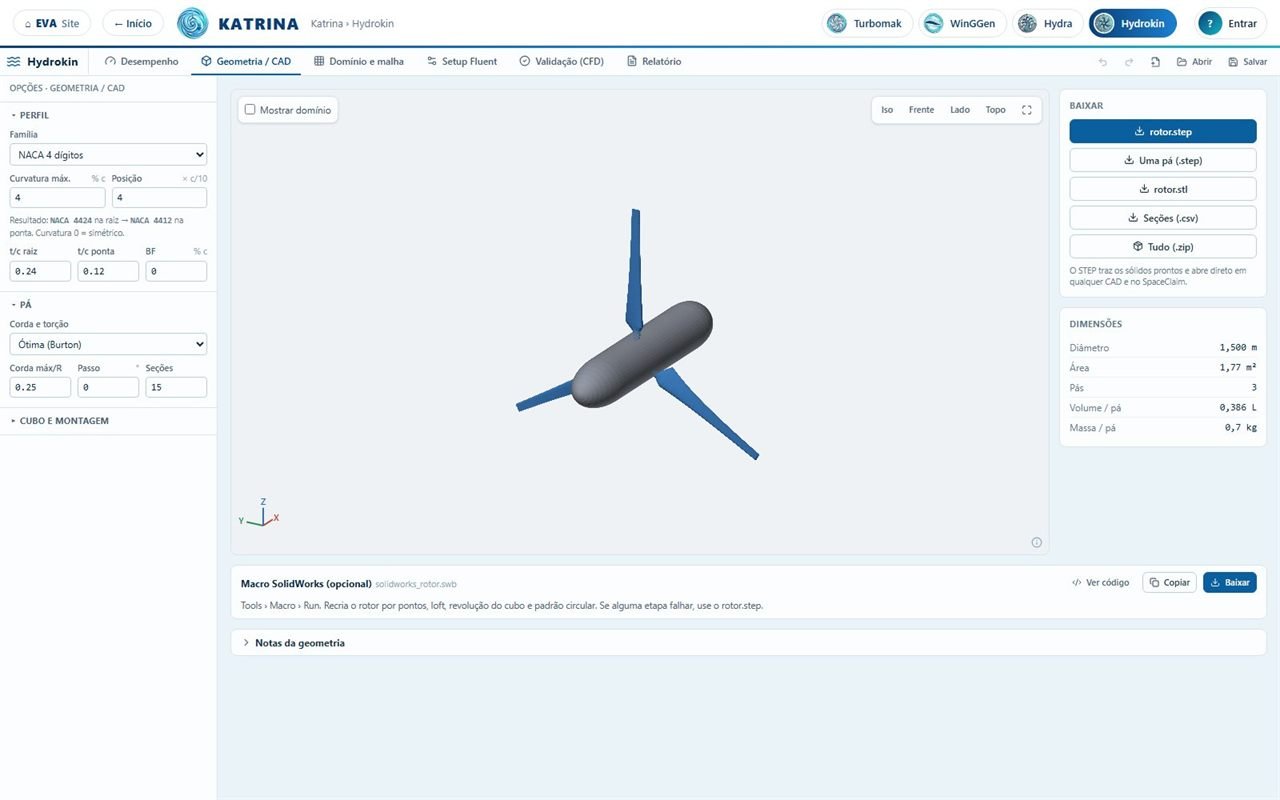
First steps
- Open Programs › Katrina › Hydrokin.
- In the Performance tab, enter the current velocity, the water temperature, the depth and the channel.
- Choose the rotor type and adjust the number of blades, TSR and airfoils.
- Continue to Geometry, Domain and mesh, Fluent setup, Validation and Report.
Calculation methods
Power and power coefficient
BEMT (axial rotor)
Each blade element combines the momentum balance (induction factors a and a′) with the airfoil forces (cl, cd). Prandtl tip and hub losses, the high-induction correction (Glauert/Buhl) and the Viterna–Corrigan post-stall extrapolation make the method valid over the whole λ range. The optimal chord and twist follow Burton et al.
Cavitation
The check is done by radius with the blade at its shallowest position (12 o'clock).
Channel blockage
When the ratio between the rotor area and the channel section exceeds about 5%, confined-channel results must be corrected to free flow (IEC TS 62600-200).
CFD guidelines
- k-ω SST model, y⁺ ≤ 1 on the blade (up to 5 acceptable) and layer growth rate between 1.15 and 1.20.
- MRF to sweep the Cp × λ curve; sliding mesh for the transient, with a step of 1° per time iteration and at least 5 to 6 revolutions.
- Mesh independence with three meshes (refinement ratio > 1.3) and GCI.
Automation with Ansys
Those who have ANSYS installed can run CAD, mesh and simulation from inside the program, without copying scripts. The scripts remain available in the Manual panel of each tab.
- Click Connect Ansys, at the top of the program, and download the connector. It uses the Python that comes with ANSYS: there is nothing to install.
- Open
iniciar_conector.batand paste into the program the token that appears in the window. One connection is valid for all tabs. - Use the Automatic panel of each step, or Run through simulation.
- Follow the residuals and reports in the charts of the Fluent tab during the calculation.
Refinement, solver controls and optimization
- Refinement of the region of interest: in Hydrokin and TurboMak, Body Size over the whole rotating domain; in WinGGen, a body of influence around the surfaces and the wake (
boi.stepfile, imported as Body of Influence). - Solver controls: coupling (SIMPLE, SIMPLEC or Coupled), under-relaxation factors, 1st- or 2nd-order schemes, 1st-order start and bad-cell handling, in the sidebar of the Fluent tab.
- Optimize mesh and solver: mesh and simulation rounds that read the residuals, the y+ on the walls of interest and the mesh quality, and adjust the design (1st layer, refinement, under-relaxation, iterations). It helps reach a simulation that converges; it does not replace the mesh independence study.
The connector runs only on your computer, accepts calls only with the token and executes only the CAD, mesh and simulation steps. The files are kept in Documentos\EVA-Ansys, ready to open by hand.
The SpaceClaim, Fluent Meshing and Fluent scripts are generated for ANSYS 2026 R1 and tested here with API simulations and syntax checking. Some commands are still being validated on real installations — each script prints to the console what it did at each step. If something fails, send those lines to EVA.
Verification and limitations
- Savonius and radial rotors use calibratable empirical curves: adjust them with tests or CFD.
- BEMT does not model the interaction between rotors in an array.
The programs support the design but do not replace the analysis of a licensed professional. Check the input data and results, and use the report as a review document.
References
- Burton, T. et al. Wind Energy Handbook. Wiley.
- IEC TS 62600-200 — Electricity producing river energy converters: power performance assessment.
- Bahaj, A. S. et al. Power and thrust measurements of marine current turbines. Renewable Energy, 2007.
- Paraschivoiu, I. Wind Turbine Design: With Emphasis on Darrieus Concept.