

 KatrinaVersion 1Updated on Oct 19, 2026
From the network layout to the right pump, cavitation-free and at the lowest cost.
Hydraulic lines: draw the network, choose pipes and fluid and get the cavitation-free pump, the lowest-cost diameters, alternative systems and the calculation report.
The problems Hydra solves
Networks and head losses
Branched and looped networks, with fittings and elevation differences, need iteration to close flow rates and pressures.
Pump and cavitation
The head, the motor and the NPSH depend on the diameters — and a suction mistake destroys the pump.
Economic diameter
Smaller pipes make construction cheaper but make the pump and energy more expensive; finding the balance takes time.
What Hydra offers
Network drawing
Reservoirs, demand nodes with minimum pressure, pipes, pumps and valves in plan view, with automatic elevations and lengths.
Gradient Method
Same formulation as EPANET: Darcy–Weisbach with Colebrook, local losses per fitting, check valves and pump curves.
Pumps and NPSH
Sizes the pump (head, speed, stages, efficiency, motor) or checks the manufacturer's curve, with available × required NPSH.
Fluids and materials
Water with properties by temperature, seawater, glycol and diesel; PVC, HDPE, steel, cast iron and copper with commercial diameters.
Optimization and alternatives
Diameters of lowest construction or life-cycle cost, and alternative systems: materials, pumps in parallel, 4-pole motor.
Calculation report
Equations, results per segment and node, pump × system curves, NPSH, hydraulic grade line, checks and costs.
From input data to result
- Draw the networkOr start from a template: pumping main, branched network, looped network or pressurization.
- Enter the dataFluid and temperature, elevations, demands, minimum pressures, materials and fittings.
- CalculateFlow rates, velocities, pressures, pump, NPSH and checks.
- Optimize and chooseCompare the alternative systems, apply the chosen one and issue the report.
Hydra screens
Click to enlarge. Use the keyboard arrows to navigate.
Methods, standards and formats
What is implemented in Hydra. The details of each method are in the manual.
See the methods in the manual →- Methods
- Global Gradient Method (Todini–Pilati), as in EPANET
- Distributed loss by Darcy–Weisbach with Colebrook–White friction factor
- Local losses by K coefficient of each fitting
- Pumps
- Generic synthesis from specific speed; estimated NPSHr
- Manufacturer curve check; pumps in parallel
- Shaft power and commercial motor
- Optimization
- Selection of commercial diameters by greedy search with pressure penalty
- Construction or life-cycle (energy) cost
- Outputs
- Printable report (PDF through the browser)
- Project as .json
Does Hydra calculate looped networks?
Yes. The Gradient Method solves branched and looped networks with the same algorithm.
Are the pipe prices real?
They are approximate references for comparing alternatives. Update the costs for your budget.
Also in Katrina
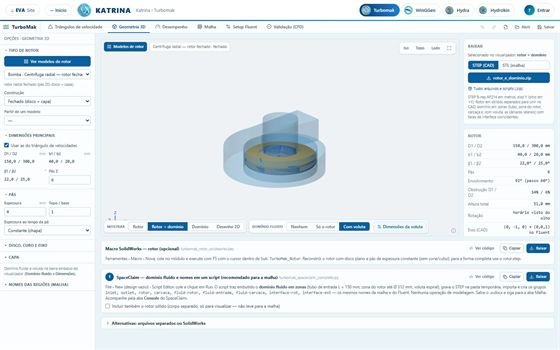
TurboMak
Pumps and hydraulic turbines: velocity triangles, 3D impeller in STEP, volute, performance curves, mesh and Fluent setup.
Explore TurboMak →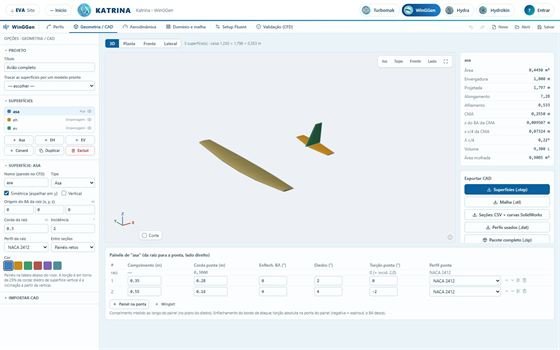
WinGGen
Wings and lifting surfaces: airfoils, parametric CAD, VLM, STEP domain, mesh and Fluent journal.
Explore WinGGen →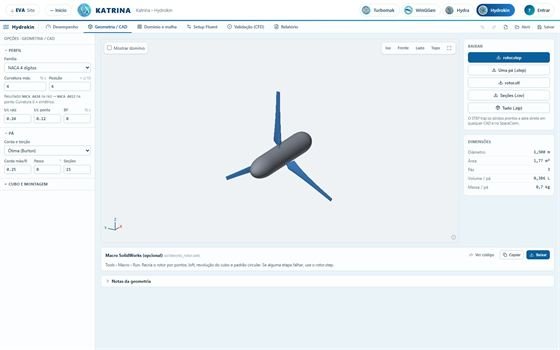
Hydrokin
Axial, H-Darrieus, Savonius and radial hydrokinetic turbines: BEMT/DMST, annual energy, STEP, mesh and Fluent.
Explore Hydrokin →Hydra is part of Katrina
Open the main program and choose the module inside it. Nothing needs to be installed.