

 KatrinaVersion 1Updated on Oct 23, 2026
From the river's velocity to a Fluent-ready rotor.
Hydrokinetic turbines (axial, H-Darrieus, Savonius and radial rotor): rotor design by BEMT or DMST, annual energy, STEP geometry, domain and mesh for Fluent Meshing, Fluent journal, GCI validation and report.
The problems Hydrokin solves
The right rotor for the site
Diameter, number of blades, tip-speed ratio, chord and twist depend on the current, the depth and the cavitation risk.
Geometry that opens in CAD
Loose airfoil sections do not become a solid; CAD macros break between versions.
Repetitive meshing and setup
Domain, boundary layer for y+, rotating interface and Fluent journal take days for every new geometry.
What Hydrokin offers
Four rotor types
Axial (HAWT) by BEMT with Prandtl losses, Glauert/Buhl high induction and Viterna post-stall; H-Darrieus by DMST; Savonius and crossflow radial rotor by calibratable curve.
Optimal blade and cavitation
Burton chord and twist (or linearized for manufacturing), NACA or imported airfoils, cavitation margin by radius with the blade at its shallowest position.
Annual energy
Cp × λ, Ct × λ and power curves, annual energy from the Weibull distribution and channel blockage per IEC TS 62600-200.
STEP geometry
B-rep solids with B-spline surfaces (blades, hub, shaft, plates), STL, sections in CSV, SolidWorks macro and SpaceClaim script with the domain.
Mesh and Fluent
2D/3D domain, first layer from y+, mesh levels by cell count, Fluent Meshing (Watertight, poly-hexcore) and solver with MRF or sliding mesh.
Validation and report
CFD or test Cp against the prediction, grid convergence index (GCI) and full report.
From input data to result
- Enter the siteDesign and mean velocity, temperature, depth and channel.
- Design the rotorChoose the type and adjust blades, TSR and airfoils while watching Cp, power and cavitation.
- Generate CAD and meshDownload the STEP and the SpaceClaim, Fluent Meshing and Fluent scripts.
- ValidateCome back with the CFD torque, check the GCI and issue the report.
Hydrokin screens
Click to enlarge. Use the keyboard arrows to navigate.
Methods, standards and formats
What is implemented in Hydrokin. The details of each method are in the manual.
See the methods in the manual →- Rotors
- Axial (HAWT), H-Darrieus, Savonius and crossflow radial
- Methods
- BEMT with Prandtl (tip and hub), Glauert/Buhl and Viterna–Corrigan corrections
- DMST (double multiple streamtube) for Darrieus
- Annual energy by Weibull; blockage per IEC TS 62600-200
- CFD
- Domain with rotating cylinder and sliding interface
- Mesh levels (300 thousand to 5 million cells) with size solved for the target
- k-ω SST, MRF for Cp × λ curves, sliding mesh for transient
- Outputs
- STEP, STL, section CSV, SolidWorks macro, SpaceClaim/Fluent Meshing/Fluent scripts
- Printable report
- Integration
- ANSYS SpaceClaim, Fluent Meshing and Fluent (2026 R1)
- CAD, mesh and simulation automation through the local Ansys connector, in the 3D domain
Learn to use Hydrokin
What is the difference from TurboMak?
Hydrokin handles rotors in free current (rivers, channels and tides); TurboMak, machines in a casing.
Can I use test data?
Yes. In Validation, enter the Cp measured or from CFD by λ and compare it with the prediction.
Also in Katrina
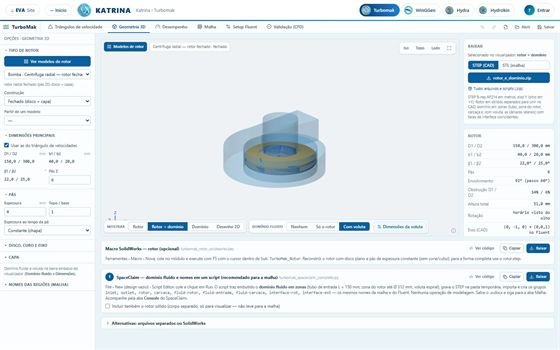
TurboMak
Pumps and hydraulic turbines: velocity triangles, 3D impeller in STEP, volute, performance curves, mesh and Fluent setup.
Explore TurboMak →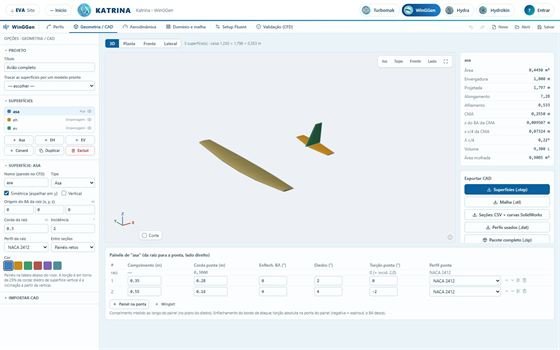
WinGGen
Wings and lifting surfaces: airfoils, parametric CAD, VLM, STEP domain, mesh and Fluent journal.
Explore WinGGen →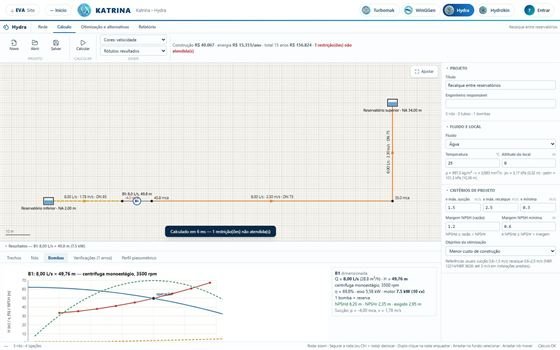
Hydra
Hydraulic lines: plan-view network, Gradient Method, cavitation-free pump, economic diameter and report.
Explore Hydra →Hydrokin is part of Katrina
Open the main program and choose the module inside it. Nothing needs to be installed.