

 KatrinaVersion 2Updated on Oct 24, 2026
From the operating point to the impeller in CAD and CFD.
Design of pumps and hydraulic turbines in a casing: impeller catalog by specific speed, velocity triangles, 3D geometry of the impeller and volute in STEP, off-design performance curves, three-zone domain, mesh and Fluent journal.
The problems TurboMak solves
Size the impeller
Flow rate, speed and head must result in consistent velocity triangles at inlet and outlet — and in a geometry that opens in CAD.
Predict the performance
Away from the design point, slip, friction and shock change head and efficiency; the machine curve must meet the system curve.
Prepare the CFD
Rotating domain, interfaces, first layer from y+ and Fluent setup are usually redone for each case.
What TurboMak offers
Illustrated impeller models
Pumps and turbines in a casing — radial, mixed, axial, Francis, Kaplan, Pelton, Banki — with drawings, specific-speed nq ranges and a suggestion for your operating point.
Velocity triangles
Pump or turbine: enter what you know and the program closes the triangles at stations 1 and 2, with Euler head, power, torque and incidence.
3D impeller in STEP and STL
Closed, semi-open, open and Banki radial impellers: disc, hub, shroud and variable-thickness blades, valid B-rep solids for SolidWorks and SpaceClaim.
Volute and three-zone domain
Inlet, impeller and casing (ring, spiral or concentric) in a single STEP, with interfaces and side chambers ready for meshing.
Off-design performance
1D curves with Wiesner slip, hydraulic efficiency, friction and shock losses, disc friction and NPSHr; affinity map and operating points with the system curve.
Mesh, Fluent and validation
First layer from y+, Fluent Meshing (poly-hexcore) or Ansys Meshing, solver journal with MRF and CFD × design comparison.
From input data to result
- Choose the machine typePump or turbine, with flow rate, speed and head; the catalog indicates the suitable impellers by specific speed.
- Solve the trianglesAt stations 1 and 2, with D, b, α, β, U, Cm, Cu, W and C.
- Generate the geometryImpeller and fluid domain in STEP, viewed in 3D and in a 2D drawing with title block.
- Evaluate the performanceCurves, affinity map and operation with the system.
- Mesh, setup and validationScripts for SpaceClaim, Fluent Meshing and Fluent; compare the results with the design.
TurboMak screens
Click to enlarge. Use the keyboard arrows to navigate.
Methods, standards and formats
What is implemented in TurboMak. The details of each method are in the manual.
See the methods in the manual →- Machines
- Centrifugal and mixed-flow pumps
- Hydraulic turbines in a casing (catalog with 36 impeller types and nq ranges)
- Methods
- Euler turbomachinery equation and velocity triangles
- Wiesner slip; hydraulic efficiency (Gülich); friction, shock and disc friction losses
- Affinity laws and system curve
- Estimated required NPSH
- Geometry
- 2D blades with camber line dθ/dr = 1/(r·tanβ), β varying linearly
- Volute by constant moment (free vortex) or constant velocity (Stepanoff), tongue calculated
- STEP AP214 with valid B-rep solids (verified in OpenCascade)
- Outputs
- STEP and STL of the impeller and fluid domain
- 2D drawing (plan and meridional section) in SVG or print
- SpaceClaim (.py), Fluent Meshing (.jou) and Fluent (.jou) scripts
- Project in .json to reopen and compare
- Integration
- ANSYS SpaceClaim, Fluent Meshing, Ansys Meshing and Fluent (developed for version 2026 R1)
- SolidWorks (alternative VBA macro)
- CAD, mesh and simulation automation through the local Ansys connector
Learn to use TurboMak
Is TurboMak suitable for hydrokinetic turbines?
No. TurboMak covers machines in a casing (pumps, turbines with volute, spiral case or pipe). For rotors in free current, use Hydrokin.
Does the STEP open in SolidWorks?
Yes. The solids are written face by face with exact surfaces and verified in OpenCascade; the non-flat caps use ruled B-spline surfaces so that SolidWorks recognizes the solid.
Can I compare several designs?
Yes. The Performance tab opens several .json files and overlays the curves.
Also in Katrina
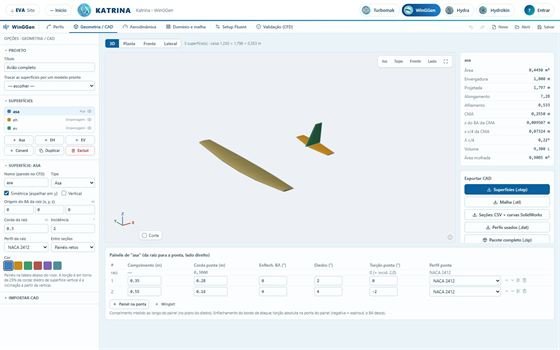
WinGGen
Wings and lifting surfaces: airfoils, parametric CAD, VLM, STEP domain, mesh and Fluent journal.
Explore WinGGen →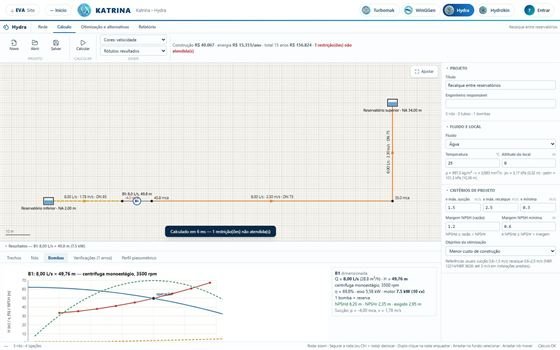
Hydra
Hydraulic lines: plan-view network, Gradient Method, cavitation-free pump, economic diameter and report.
Explore Hydra →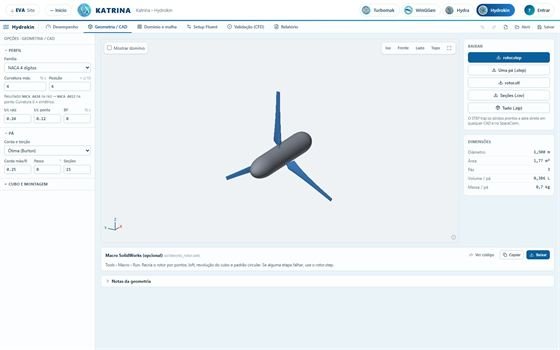
Hydrokin
Axial, H-Darrieus, Savonius and radial hydrokinetic turbines: BEMT/DMST, annual energy, STEP, mesh and Fluent.
Explore Hydrokin →TurboMak is part of Katrina
Open the main program and choose the module inside it. Nothing needs to be installed.