

Hydra
Hydraulic lines: draw the network, choose pipes and fluid and get the cavitation-free pump, the lowest-cost diameters, alternative systems and the calculation report.
Version 1 · updated on Oct 19, 2026
Overview
Hydra sizes pressurized hydraulic lines and networks: it calculates flow rates and pressures, chooses the pump and checks cavitation, optimizes diameters and compares alternative systems.
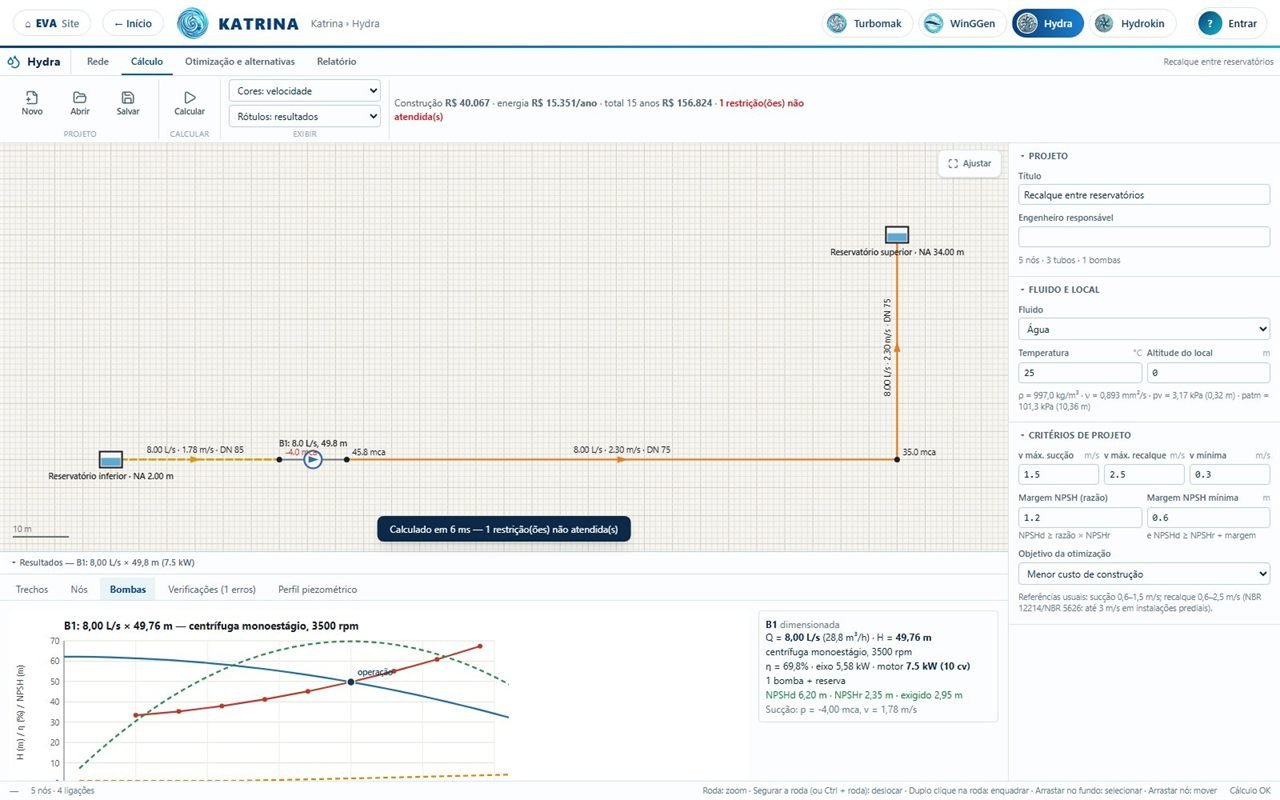
First steps
- Open Programs › Katrina › Hydra.
- Start from a template (simple pumping main, branched network, looped network or pressurization) or draw in the Network tab.
- Define the fluid and temperature, the elevations, the demands and the minimum pressures.
- Calculate, optimize and issue the report.
The program tabs
| Tab | What it does |
|---|---|
| Network | Plan-view drawing: reservoirs, nodes, pipes, pumps and valves, with properties in the sidebar. |
| Calculation | Solves the network and shows flow rates, velocities, pressures, pump × system curve and NPSH. |
| Optimization and alternatives | Lowest-cost diameters and alternative systems side by side. |
| Report | Printable calculation report. |
Calculation methods
Pressure drop
Gradient Method
The energy equations in the segments and the continuity equations at the nodes are solved simultaneously by Newton–Raphson (Todini and Pilati formulation), the same one used in EPANET. Pumps enter as segments with head gain given by the curve, and check valves prevent reverse flow.
NPSH
The required NPSH of the synthesized pump is estimated from the suction specific speed.
Results and export
- Results per segment (flow rate, velocity, loss) and per node (pressure, head).
- Pump: head, flow rate, speed, stages, efficiency, power and motor.
- Report with equations, tables, charts and costs — print to PDF through the browser.
Verification and limitations
- The routines are verified against analytical solutions (
testes/verificar.ts). - The regime is steady: hydraulic transients (water hammer) are not calculated.
- Costs are references; adjust them to your market.
The programs support the design but do not replace the analysis of a licensed professional. Check the input data and results, and use the report as a review document.
References
- Todini, E.; Pilati, S. A gradient algorithm for the analysis of pipe networks. 1988.
- Rossman, L. A. EPANET 2 Users Manual. US EPA.
- Porto, R. M. Basic Hydraulics. EESC-USP.
- ABNT NBR 12214 — Design of water pumping systems for public supply.